

Jetting lance foot injury prompts WJA safety alert
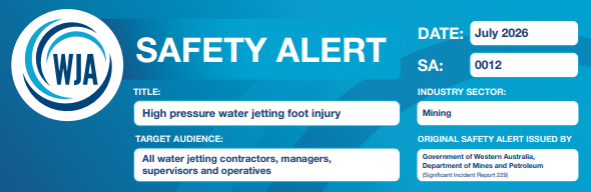
The Water Jetting Association has issued a safety alert after a high pressure water jet went through an operative’s foot while he was cleaning industrial equipment.
The operative had been holding a hand lance between his legs, which allowed the water jet to penetrate one of the wellington boots he had been wearing and then go through the ball of his foot.
The incident happened in Australia where it was investigated by the Government of Western Australia’s Department of Mines and Petroleum, which issued a Significant Incident Report.
Actions recommended by the WJA
The WJA was sent the report by its counterpart in Australia, the Australasian High Pressure Water Jetting Association (AUSJET), resulting in learning points incorporated into WJA Safety Alert 0012.
Issues the incident raises include: risk assessment, water jetting equipment safety, use of PPE, work area visibility, operative training, and water jetting injury awareness.
WJA Technical Manager Gordon Taylor said: “For UK water jetting contractors, the incident illustrates the importance of using hand lances that comply with guidance in the WJA Code of Practice.
“This requires lances to have a minimum length of 1.1m, from the centreline of the rear handle grip to the nozzle holder. This is designed to prevent the lance from being pointed directly at any part of the operative’s body.”
Applying the hierarchy of control
The incident also highlights the importance of carrying out a robust risk assessment that takes account of the hierarchy of control.
This is a structured approach used in safety management to minimise or eliminate hazards. It prioritises using control methods from most effective to least effective, in the following order:
1. Elimination: Completely remove the hazard from the workplace, such as automating a manual task.
2. Substitution: Replace a hazardous material or process with one that is less hazardous.
3. Engineering Controls: Isolate people from the hazard through physical means, such as machine guards.
4. Administrative Controls: Implement policies and procedures to reduce risks, including carrying out appropriate training.
5. Personal Protective Equipment (PPE): Used as a last resort to protect workers from exposure. Remember, no PPE can offer total protection.
View – WJA Safety Alert 0012 – Hand Lance Water Jetting Injury
View – All WJA Safety Alerts